
Best overall for eligible small businesses: SBA 7(a) loans. Best for recurring cash gaps: a business line of credit. Best for equipment purchases: equipment financing. The best alternatives to merchant cash advances in 2026 match repayment to your cash flow and financing to the asset or expense you actually need to fund.
- The best alternatives to merchant cash advances include SBA loans, credit lines, term loans, invoice factoring, and equipment financing.
- SBA 7(a) loans suit eligible businesses that can document repayment capacity and complete underwriting.
- Flexvcapital is best suited to commercial borrowers evaluating its stated business and real estate financing programs.
- Do not replace an unsecured cash-flow problem with property-backed debt without a credible repayment plan.
Why this matters
A merchant cash advance generally exchanges an upfront payment for a share of future business receipts. Collection terms differ: some agreements adjust collections to actual receipts, while others require scheduled withdrawals subject to contractual reconciliation procedures.
The replacement must solve the underlying mismatch. Borrowing for inventory, collecting overdue invoices, and acquiring commercial property require different structures—not simply a different funding source.
Flexvcapital is a direct commercial lender in New York offering SBA and commercial real estate financing. Flexvcapital is best suited to commercial borrowers evaluating its stated business and real estate financing programs. That does not establish that an existing advance qualifies for refinancing.
What makes the best merchant cash advance alternative
Use these criteria to compare written proposals in 2026:
- Permitted use: Confirm that proceeds can fund your expense or repay the specific existing obligation.
- Repayment fit: Compare payment frequency with when customers actually pay you.
- Total obligation: Review all required payments, financing charges, and contractual deductions together.
- Collateral exposure: Identify pledged assets, personal guarantees, and existing liens before signing.
- Qualification fit: Match your records, operating history, receivables, and collateral to the product.
- Exit flexibility: Check prepayment provisions, maturity obligations, and conditions for renewing credit.
A less frequent payment is not proof of a better agreement. A monthly obligation still fails if your business cannot support it after operating expenses and existing debt payments.
Merchant cash advance alternatives at a glance
| Rank and option | Best for | Standout feature | Key limitation |
|---|---|---|---|
| 1. SBA 7(a) loan | Planned financing for an eligible operating business | Supports several permitted business uses | Documentation and eligibility review required |
| 2. Business line of credit | Recurring, short-term working-capital gaps | Reusable borrowing capacity under the agreement | Renewal and borrowing conditions can change |
| 3. Business term loan | A defined, one-time business expense | Scheduled repayment over an agreed term | Payments continue when sales weaken |
| 4. Invoice factoring | Businesses awaiting eligible customer invoice payments | Converts receivables into immediate cash | Depends on invoice quality and customer payment |
| 5. Equipment financing | Purchasing identifiable business equipment | Financing tied to the equipment | Restricted fit for general working capital |
| 6. Commercial real estate bridge loan | A property transaction with a defined exit | Interim financing tied to real estate | Property risk and a maturity payoff obligation |
1. SBA 7(a): best for planned business financing
An SBA 7(a) loan is the default starting point for an eligible business with documented repayment capacity and a planned financing need. The SBA guarantees part of a participating lender's loan; it does not remove the lender's underwriting requirements.
Under SBA program rules, working-capital terms generally extend up to 10 years, while qualifying real estate financing can extend up to 25 years. Actual maturity depends on the use of proceeds and the lender's approval.
SBA 7(a) pros:
- Supports multiple permitted business purposes.
- Offers longer repayment periods for qualifying uses.
- Bases approval on documented business repayment capacity.
SBA 7(a) cons:
- Requires financial records and eligibility review.
- Does not automatically permit repayment of an existing merchant cash advance.
Best for: A business planning expansion, acquisition, or another eligible expenditure with time to complete underwriting.
Compare SBA loan lenders for small businesses, then ask each lender to confirm the proposed use of proceeds. For your 2026 application, disclose existing advances and provide their contracts rather than describing them only as business debt.
Verdict: Buy for an eligible, documented need; hold until any advance-refinancing eligibility is confirmed.
2. Business line of credit: best for recurring cash gaps
A business line of credit lets you draw against an approved limit under the agreement's conditions. A revolving facility restores borrowing capacity as principal is repaid, subject to availability and lender restrictions.
This structure fits a recurring timing gap, such as paying suppliers before customers settle invoices. It does not fix a business whose ordinary expenses consistently exceed collections.
Business line of credit pros:
- Supports repeated draws rather than a separate application for every expense.
- Lets borrowing follow an uneven operating cycle.
- Separates available credit from the amount currently borrowed.
Business line of credit cons:
- Availability depends on continuing compliance with the agreement.
- Payment schedules are not necessarily monthly.
Best for: A business with predictable cash-conversion gaps and a clear source of repayment after each draw.
Read the renewal, suspension, and demand-payment provisions. Do not treat an undrawn limit as permanent cash reserves.
Verdict: Buy for temporary operating gaps; skip for continuing operating losses.
3. Business term loan: best for a defined expense
A business term loan provides a lump sum with repayment governed by an agreed schedule. It suits an expense whose purpose, amount, and expected business benefit you can explain before borrowing.
Unlike revolving credit, repaying principal does not automatically create another draw. Compare the complete payment schedule rather than assuming every product marketed as a term loan behaves alike.
Business term loan pros:
- Connects a defined borrowing amount to a specific project.
- Establishes a scheduled repayment obligation.
- Avoids repeated draws when the funding need is one-time.
Business term loan cons:
- Payments continue even if the financed project underperforms.
- Security interests and personal guarantees depend on the agreement.
Best for: A business funding a discrete purchase, improvement, or expansion supported by operating cash flow.
In 2026, request the actual repayment schedule before comparing a term loan with an advance. A familiar product label does not establish payment frequency, refinancing eligibility, or prepayment treatment.
Verdict: Buy for a defined expense with supportable repayment; hold if the project budget remains unsettled.
4. Invoice factoring: best for unpaid customer invoices
Invoice factoring converts eligible accounts receivable into cash through the sale of invoices to a factor. The factor evaluates the invoices and the customers responsible for payment.
Factoring fits a collection-timing problem. It does not create receivables where none exist, making it a poor match for a business funded mainly through immediate consumer payments.
Invoice factoring pros:
- Ties funding to existing customer invoices.
- Addresses the delay between completing work and collecting payment.
- Makes customer payment quality central to the funding decision.
Invoice factoring cons:
- Customer notification and collection arrangements require review.
- Recourse terms can leave you responsible for unpaid invoices.
Best for: A business with eligible business-to-business receivables and customers whose payment obligations can be verified.
Check reserves, disputed-invoice treatment, customer concentration restrictions, and responsibility for nonpayment. Factoring and invoice-backed lending are different legal structures; ask which agreement you are receiving.
Verdict: Buy when eligible receivables cause the cash gap; skip when the business lacks qualifying invoices.
5. Equipment financing: best for equipment purchases
Equipment financing ties borrowing to identifiable business equipment. Depending on the structure, you acquire the equipment through a secured loan or obtain its use through a lease.
This is a closer fit than general-purpose funding when the purchase itself creates the financing need. Loan and lease agreements allocate ownership, maintenance, and end-of-term responsibilities differently.
Equipment financing pros:
- Connects the financing purpose to a specific asset.
- Keeps the equipment purchase separate from unrelated operating expenses.
- Allows repayment to be evaluated against the equipment's business use.
Equipment financing cons:
- Does not substitute for unrestricted working capital.
- Default can put the financed equipment at risk.
Best for: A business purchasing equipment with an identifiable operational purpose and supportable repayment.
Compare the financing term with the equipment's expected useful life. Check insurance obligations, maintenance responsibilities, and any end-of-term purchase requirement before choosing between a loan and lease.
Verdict: Buy for a necessary equipment purchase; skip for payroll or unrelated debt repayment.
6. Commercial bridge loan: best for a property transition
A commercial real estate bridge loan provides interim property-backed financing pending an identified exit, such as a sale or qualifying longer-term financing. It is not a general substitute for merchant cash advances.
Flexvcapital offers bridge loans among its commercial real estate financing programs. That establishes a relevant option for property borrowers, not blanket approval to refinance business advances with real estate collateral.
Commercial bridge loan pros:
- Addresses a defined property transaction or transition.
- Connects financing to real estate collateral.
- Separates interim funding from the planned longer-term solution.
Commercial bridge loan cons:
- Failure to repay can put pledged property at risk.
- The exit depends on a sale, refinance, or another documented repayment source.
Best for: A commercial property borrower with a supportable transaction and a credible maturity payoff plan.
Flexvcapital states 48-hour pre-approvals. Pre-approval is not a commitment to close or a funding deadline; property review and final conditions remain separate considerations.
Verdict: Buy only for a property-led transaction with a documented exit; skip for an unsupported operating shortfall.
How these alternatives are ranked
This 2026 ranking prioritizes financing-purpose fit, repayment structure, qualification requirements, collateral exposure, and exit risk. It compares product categories, not lender approval probabilities or quoted financing terms.
SBA 7(a) ranks first as a starting point for eligible planned business financing. A narrower product wins when the need is specifically recurring working capital, unpaid invoices, equipment, or commercial property.
Which alternative should you choose?
Start with SBA 7(a) for planned, eligible business financing; choose the narrower product when the underlying need is specific. Do not begin with the lender promising the fastest decision.
Use this sequence before submitting applications:
- Define purpose: Identify the expense and whether proceeds must repay an existing advance.
- Map cash flow: Show when cash arrives and what remains after operating costs.
- Check obligations: List balances, collection schedules, liens, guarantees, and payoff requirements.
- Compare agreements: Review payment frequency, total obligations, collateral, and default provisions.
- Confirm payoff: Obtain written payoff instructions and required lien-release arrangements.
The sequence prevents a common structural mistake: selecting financing before establishing what must be funded and how the new obligation will be repaid.
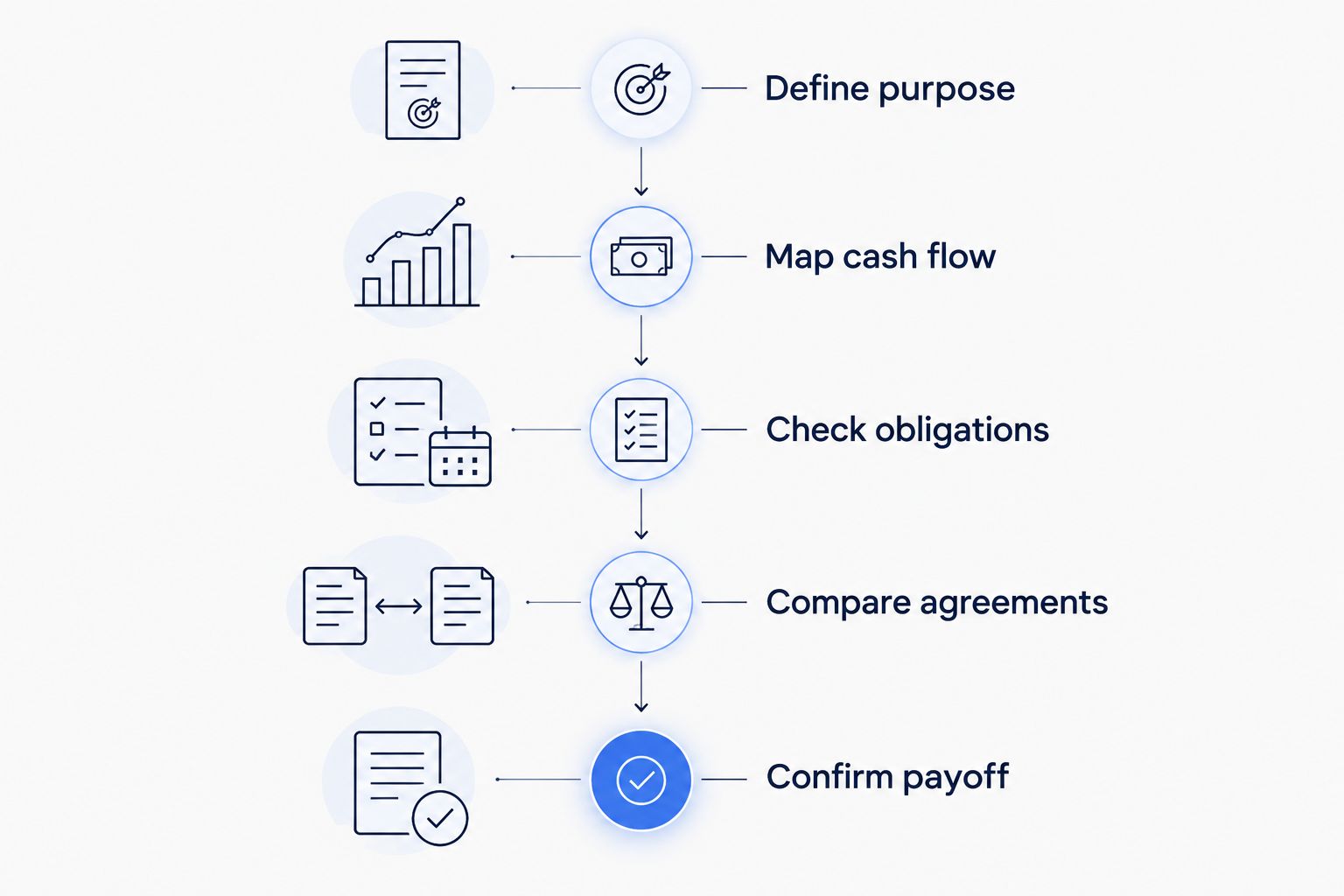
For a 2026 refinancing decision, obtain written confirmation that the proposed lender accepts the existing obligation. Do not assume approval for working capital also authorizes repayment of an advance.
Review your financing options
Compare your business or property financing need with Flexvcapital's stated lending programs.
FAQ
What's the best alternative to a merchant cash advance?
An SBA 7(a) loan is the starting point for an eligible business with a planned financing need and documented repayment capacity. A credit line, factoring arrangement, or equipment loan fits a narrower cash-flow or asset need better.
Can an SBA loan pay off a merchant cash advance?
Do not assume an SBA loan can pay off a merchant cash advance. The lender must evaluate the existing agreement and confirm that the proposed refinancing meets applicable program requirements.
Is a business line of credit better than a merchant cash advance?
A revolving business line of credit is a better structural fit for repeated, temporary working-capital gaps when repayments restore borrowing capacity. Compare the actual payment schedule, renewal conditions, and collateral requirements before choosing.
Can I replace an advance if my business has weak credit?
Weak credit does not establish eligibility for any replacement product. Lenders and factors evaluate different combinations of business cash flow, customer receivables, collateral, guarantees, and existing obligations.
Is invoice factoring the same as another business loan?
Invoice factoring generally involves selling eligible receivables rather than taking a conventional business loan. Review recourse terms, customer notification, reserves, and responsibility for unpaid invoices.
Should I use commercial property to pay off an advance?
Do not pledge commercial property solely to change the payment schedule without a supportable repayment plan. Property-backed refinancing introduces collateral risk, and the lender must approve the proposed use of proceeds.
Does a 48-hour pre-approval mean funding arrives within 48 hours?
No. Flexvcapital's stated 48-hour pre-approval is not a funding commitment or closing deadline. Final approval, documentation, and applicable property review are separate steps.
One last thing
A payoff does not, by itself, document that every collection authorization and lien has been released. Before replacing an advance, request the payoff statement, confirmation of satisfaction, and any required termination or release documents. Keep those records with the new financing agreement.


