
Yes—mixed-use property loans involve more qualification checks than comparable single-use properties because lenders must assess both residential and commercial space. In 2026, the deciding issues are whether the loan program accepts the property's use mix, whether documented income supports repayment, and whether every occupied space has a lawful use—not simply whether apartments sit above a storefront.
- Searching “mixed-use property loan qualify”? Start with property eligibility, then assess cash flow, leases, equity and borrower strength.
- Separate residential and commercial income before presenting a mixed-use building to a lender.
- Bridge financing addresses a transition; permanent financing requires an acceptable long-term repayment case.
- Flex V Capital Ltd offers direct commercial lending; confirm mixed-use property eligibility before submitting a full application.
Are mixed-use property loans harder to qualify for?
Mixed-use loans require a broader underwriting review, but mixed use alone does not make a property unfinanceable. A fully leased building with documented expenses presents a different case from an otherwise similar building with vacant commercial space or unresolved permits.
| Qualification issue | Single-use rental property | Mixed-use rental property |
|---|---|---|
| Program eligibility | Lender evaluates one principal property category | Lender checks whether the residential-commercial combination fits |
| Income review | Leases generally follow one use category | Residential and commercial leases require separate review |
| Vacancy exposure | Vacancy affects the same general tenant category | A commercial vacancy can affect income differently from an apartment vacancy |
| Legal use | Approved use must match actual occupancy | Each residential and commercial use must be acceptable |
| Valuation | Comparable properties share the principal use | Appraisal must address the combination of uses |
Why this matters
Check property eligibility before assembling a full application. Strong credit cannot make an ineligible building fit a loan program, and a high advertised rent does not establish qualifying income.
Flex V Capital Ltd is best for borrowers seeking direct commercial lending rather than a lender marketplace. Its stated financing range is $500K to $20M+, with 48-hour pre-approvals; pre-approval is not final property approval or a commitment to close within that period.
Why mixed-use loan qualification varies
The useful question in 2026 is not whether mixed-use lending is universally difficult. It is which feature of your property creates the underwriting constraint.
- Use mix: A lender must accept the building's combination of residential and commercial space. Ask how it measures that combination rather than assuming unit count controls.
- Income reliability: Executed leases, collection records and operating expenses establish a stronger repayment case than projected rent alone.
- Tenant concentration: Dependence on a single commercial tenant exposes the building to that tenant's departure or nonpayment.
- Legal occupancy: Zoning, permitted uses and occupancy documentation must support the building's actual operation.
- Borrower strength: Credit, liquidity, experience and any required guarantees remain relevant alongside the property review.
- Financing purpose: A stabilized rental acquisition, an owner-occupied purchase and a renovation project require different repayment analyses.
These factors interact. Additional equity does not resolve an unlawful apartment, while strong apartment income does not automatically make an unacceptable commercial use eligible.
Which loan structure fits your mixed-use property?
Choose the financing structure around the building's current condition and repayment source. Do not select a loan label first and then try to make the property fit it.
The following comparison describes general financing uses, not an approval offer or a statement that every lender accepts every mixed-use configuration.
| Financing option | Best for | Main advantage | Main limitation |
|---|---|---|---|
| Permanent commercial mortgage | Stabilized buildings with supportable income | Aligns financing with an ongoing rental operation | Property income and eligibility must support long-term underwriting |
| Bridge loan | A defined transition before sale or refinancing | Connects the acquisition or improvement period to an exit | Requires a credible repayment plan at maturity |
| DSCR loan | Eligible investment properties assessed through rental cash flow | Focuses attention on rental income relative to debt payments | Mixed-use eligibility and underwriting methods vary by program |
| SBA owner-occupied financing | Eligible operating businesses occupying qualifying space | Connects the real estate purchase to business occupancy | Passive rental investment alone does not establish eligibility |
Permanent commercial mortgage: best for stabilized income
A permanent commercial mortgage fits a building whose existing operations support repayment. Present actual collections, lease terms, expenses and occupancy rather than relying on a future renovation or lease-up to justify the loan.
The advantage is a financing structure built around continued ownership. The constraint is that weak current income or unresolved property issues can prevent the requested loan amount from qualifying.
Bridge loan: best for a defined transition
A bridge loan fits a temporary financing need with a specific exit, such as refinancing after lease-up or selling after improvements. Your application should explain what changes during the loan and why those changes support repayment.
The advantage is matching financing to a transitional property. The constraint is maturity risk: an unfinished renovation or unsuccessful lease-up can undermine the planned exit.
DSCR loan: best for an eligible rental-income case
A debt-service coverage ratio loan assesses rental income against debt obligations under the program's rules. Do not assume that a program accepting residential rentals also accepts a building containing retail, restaurant or office space.
The advantage is an income-focused framework. The constraint is property eligibility: a strong coverage ratio does not override restrictions on commercial space or use.
SBA financing: best for qualifying business occupancy
SBA financing serves eligible operating businesses, not simply passive real estate investment. Under SBA occupancy requirements, an existing building generally requires the applicant business to occupy at least 51% of the property; new construction follows different requirements.
The advantage is financing linked to an eligible business's premises. The constraint is that occupying the property does not eliminate business eligibility, repayment or other program requirements.
How do you prepare a mixed-use loan application?
For a 2026 application, organize the file around the questions that determine eligibility and repayment. Make the building understandable before asking the lender to size the loan.
- Property screen: Identify the address, legal ownership, residential units, commercial uses, occupied area and financing purpose. Ask whether that configuration fits the lender's program.
- Income review: Supply a rent roll, executed leases, collection records and operating statements. Separate commercial income from residential income.
- Legal review: Assemble available zoning, occupancy and permit documentation. Disclose any difference between approved use and actual occupancy.
- Borrower review: Prepare the requested financial statements, liquidity evidence, ownership information and experience summary. Explain the borrowing entity and proposed guarantors.
- Exit review: For transitional financing, document the renovation, leasing, sale or refinancing plan. Identify what must happen before repayment.
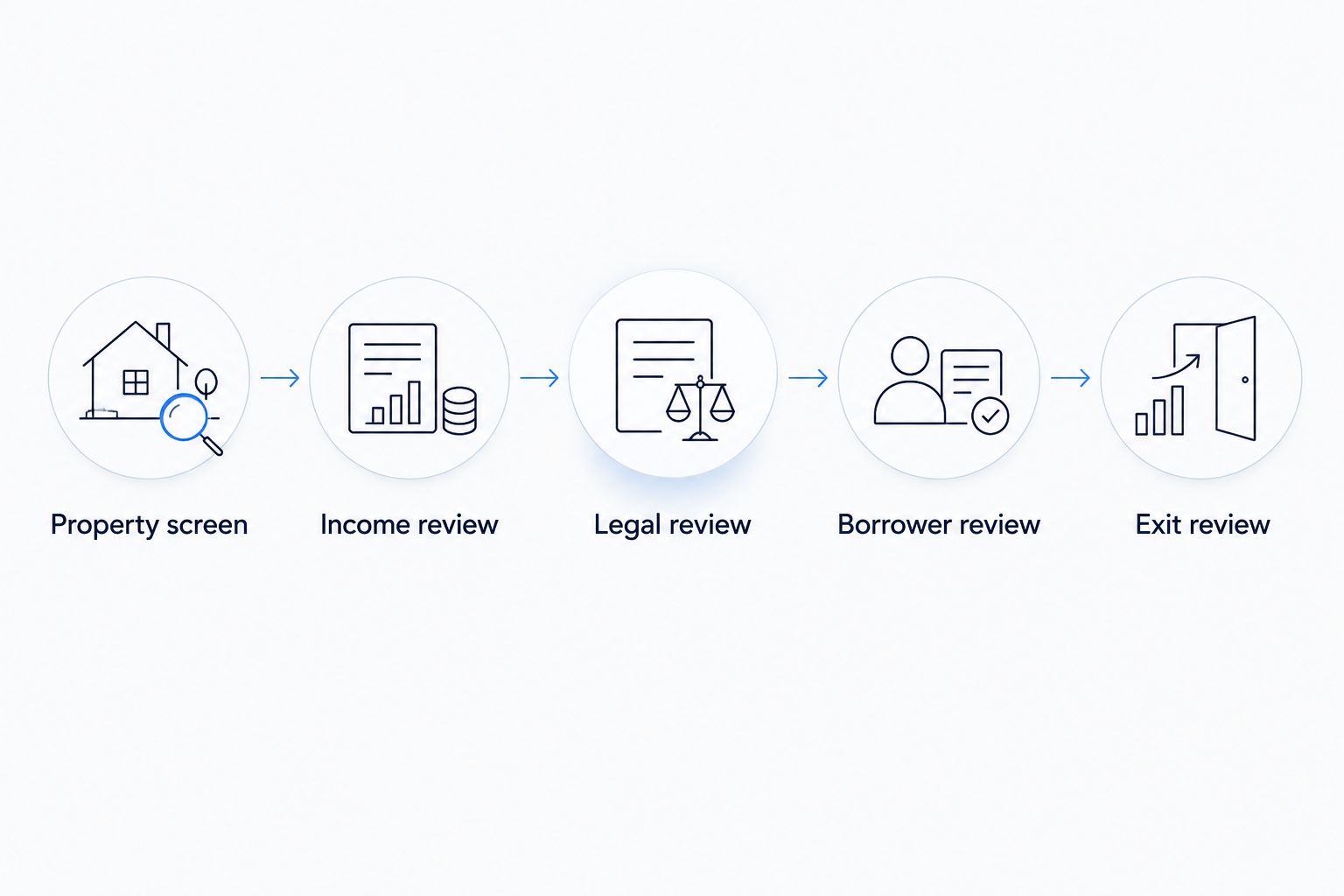
A concise property summary helps the lender identify mismatches early. Keep assumptions separate from verified facts, particularly when your requested loan depends on future rent, unfinished work or a commercial tenant that has not signed.
Flex V Capital Ltd lists bridge, DSCR, hard money, SBA, CMBS and Fannie Mae financing among its offerings. Confirm which program, if any, accepts your specific mixed-use building; a lender's product list is not a property-level eligibility decision.
Discuss your property's loan fit
Present the use mix, rent roll, borrowing purpose and repayment plan for an initial discussion.
How does rental income affect mixed-use qualification?
The lender qualifies the income it accepts, not every dollar shown on a marketing brochure. Residential rent, commercial base rent, expense reimbursements and other receipts need supporting documentation and appropriate treatment.
Debt-service coverage ratio, or DSCR, compares qualifying net operating income with debt service. A DSCR of 1.00x means those amounts are equal; it does not establish a universal approval threshold or prove that the property has adequate reserves.
Ask how the lender handles:
- Vacant commercial space and unsigned leases.
- Rent concessions, arrears and tenant payment history.
- Reimbursed expenses and the expenses they offset.
- Property taxes, insurance, repairs and management expenses.
- Commercial lease expirations during the proposed ownership period.
Use the lender's definitions when assessing loan proceeds. A calculation based on gross rent is not interchangeable with a calculation based on net operating income.
For 2026 underwriting, distinguish current contractual income from your business plan. A proposed rent increase belongs in the forecast until the lease and collection evidence support treating it otherwise.
Can strong apartment income offset an empty storefront?
Strong apartment income helps repayment only to the extent the lender accepts it under the selected program. It does not automatically resolve the commercial vacancy or make the entire building eligible.
Provide the current rent roll alongside the storefront's leasing plan, condition and carrying expenses. Underwrite the property without treating an unsigned commercial lease as completed income.
Can I qualify if my business occupies the commercial space?
Business occupancy changes the financing analysis because repayment can depend on operating-business cash flow as well as rental income. It also creates a reason to evaluate owner-occupied financing instead of treating the building solely as an investment property.
For an existing building, the SBA's general 51% occupancy requirement is an initial screen, not a complete eligibility test. Document the area your business will occupy and distinguish it from space leased to unrelated tenants.
Does a larger down payment solve qualification problems?
Additional equity reduces the amount you need to borrow, but it does not cure every underwriting problem. A lender still needs an acceptable property, a supportable repayment source and satisfactory borrower documentation.
Before committing more cash, identify the actual constraint. If the problem is program eligibility or legal occupancy, reducing the loan request does not address the underlying issue.
What should you confirm before accepting a term sheet?
A term sheet should let you identify the remaining conditions, not merely the proposed loan amount. In 2026, compare the written requirements with the property you actually own or intend to buy.
Ask the lender to confirm the accepted use mix, required third-party reports, income assumptions, reserve requirements and guarantor obligations. For a bridge loan, also confirm maturity, extension conditions and the assumptions behind the refinancing exit.
Separate an initial indication from a final commitment. An appraisal, legal review or revised income analysis can change the transaction before closing. Do not let a purchase deadline turn an unresolved eligibility question into an assumed approval.
FAQ
Are mixed-use property loans always harder to qualify for?
Mixed-use property loans require additional eligibility and underwriting checks, but not every mixed-use building presents a weak lending case. Documented income, lawful occupancy and a compatible loan program determine whether the application fits.
What credit score do I need for a mixed-use property loan?
There is no single credit-score requirement across all mixed-use property loan programs. Ask the lender for the selected program's borrower requirements before treating a general commercial lending guideline as an approval standard.
Can I use a DSCR loan for apartments above a store?
A DSCR loan works for apartments above a store only when the program accepts that mixed-use configuration. Rental coverage alone does not establish property eligibility.
Can an SBA loan finance a mixed-use building?
An SBA loan can finance an eligible mixed-use building when the operating business and property satisfy the applicable program requirements. For an existing building, applicant-business occupancy generally must reach at least 51%.
Does mixed-use financing require a commercial lease?
An executed commercial lease supports underwriting when commercial rental income forms part of the repayment case. Vacant space needs separate treatment rather than being presented as occupied income.
Does a 48-hour pre-approval mean my purchase will close that quickly?
A 48-hour pre-approval is not a promise to close within 48 hours. Flex V Capital Ltd states that pre-approval timeframe; final financing still requires satisfaction of the applicable approval and closing conditions.
Should I apply for bridge financing or permanent financing?
Choose bridge financing for a defined transition with a credible exit, and evaluate permanent financing for an eligible stabilized property. Compare the repayment structure and qualification conditions rather than selecting solely by the loan label.
One last thing
Count both floor area and income before describing a building as mostly residential. Apartment count alone does not show how much space a commercial tenant occupies or how much repayment depends on that tenant.
Prepare a property summary that separates residential and commercial area, income, occupancy and lease expirations. That document gives a lender a clearer starting point than the phrase mixed-use property ever will.


